
Copper Craft of Kabul: Afghan Coppersmiths

Walk through the coppersmith bazaar in the old quarter of Kabul and the first thing that strikes you is the sound — a continuous, rhythmic hammering of metal on metal, dozens of hammers falling at different speeds and pitches, blending into a complex percussion that echoes off the walls of the narrow lane. This is one of the oldest continuously operating craft bazaars in Central Asia, and the coppersmiths who work here are carrying on a tradition that has been practised in this city for centuries. The tools are simple — a hammer, a stake, a few chisels, a charcoal brazier — but the skill required to turn a flat disc of copper into a functional and beautiful teapot, tray, or bowl is profound, and it takes years of apprenticeship to master.
Raising: How a Teapot Is Born from a Flat Sheet
The fundamental technique of Kabul copperwork is called raising — the process of hammering a flat sheet of metal into a three-dimensional vessel without cutting, folding, or welding. The coppersmith begins with a flat circular disc of copper sheet, typically one to two millimetres thick. He places the disc over a shaped steel stake — a heavy, polished form fixed to a stump or a bench — and begins hammering with a slightly domed hammer, working from the centre of the disc outward in concentric rings. Each ring of hammer blows compresses and stretches the metal slightly, causing it to curve upward around the stake. After completing a full circuit, the smith moves the disc slightly and begins another ring.
Gradually, over hundreds of passes, the flat disc rises into a shallow bowl, then a deeper bowl, then a vessel. The process requires constant rotation of the workpiece and careful control of the hammer’s angle and force. Too much force in one area will thin the metal and create a weak point; too little will leave a flat spot. The smith must also periodically anneal the copper — heating it to a dull red in the charcoal brazier and then quenching it in water — to soften the metal and relieve the stresses that accumulate during hammering. Without annealing, the copper becomes work-hardened and brittle, and it will crack rather than deform.
A teapot requires additional components that are made separately and attached by hand. The spout is raised from a smaller disc and soldered to the body of the pot. The lid is hammered to fit the specific pot it was made for — lids are not interchangeable between pots because each body has a slightly different rim diameter. The handle is cast in brass with a gap between it and the body of the pot so that it stays cooler than the vessel itself. Each of these components involves its own set of forming, fitting, and finishing operations, and a complete teapot represents several days of skilled labour.
The Surface: Reading the Tool Marks
The entire surface of a hand-raised copper vessel is covered with the overlapping dimple marks of the hammer. These marks are not a decorative choice — they are the unavoidable trace of the forming process, and they are what distinguishes genuine hand-raised copperware from machine-spun or stamped alternatives. Machine-spun copper is perfectly smooth and featureless, produced by pressing a sheet of metal against a spinning mandrel with a polishing tool. Stamped copper is formed in a single press operation and bears the marks of the die rather than a hammer. Only hand-raised copper has the characteristic irregular, overlapping dimple pattern that records the individual blows of a human craftsman working at a hand-operated stake.
Qalai: The Art of Tin Lining
Copper is a reactive metal. When it comes into contact with acidic food or drink — tea, tomato, vinegar, citrus — it produces copper salts that are toxic in quantity and give food a metallic, unpleasant taste. For this reason, every copper vessel intended for food or drink use must be lined with tin, a process the Afghans call qalai. The qalai process is a specialised skill, often performed by a dedicated craftsman rather than by the coppersmith who made the vessel. The pot is heated over a charcoal brazier until it is hot enough to melt tin. A stick of pure tin is then touched to the interior surface, where it melts on contact and flows across the copper. The craftsman uses a wad of cotton or cloth to spread the molten tin evenly across the interior, wiping it into every curve and corner. When the pot cools, the interior is coated with a smooth, silvery-white layer of food-safe tin.
With daily use — boiling water for tea, cooking rice or soup — the tin lining will gradually wear away over a period of three to five years. When you can see patches of pink copper showing through the silver tin, it is time to have the pot re-tinned. This is a routine maintenance operation, not a repair, and any coppersmith or tinsmith can perform it in a few minutes for a nominal charge. Do not cook in a copper vessel whose tin lining has worn through — the exposed copper will contaminate your food.
Decorative Techniques
Beyond the basic forming of the vessel, Kabul coppersmiths employ several decorative techniques to embellish their work:
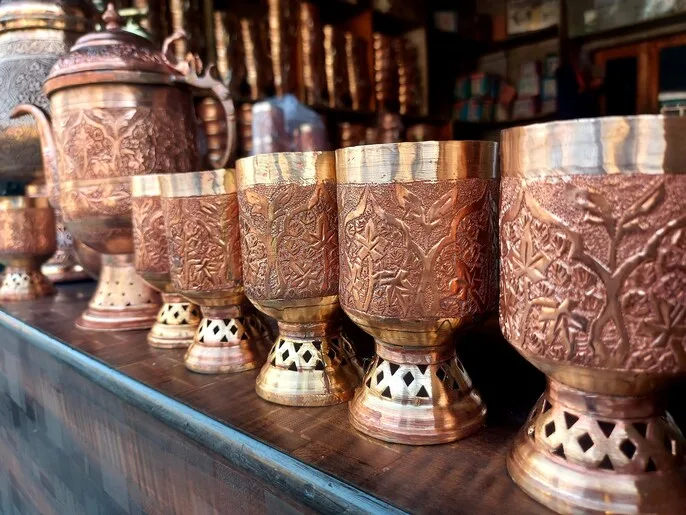
- Chasing is the process of hammering decorative patterns into the surface of the copper from the front face, using small shaped chisels and punches. The most common motifs are floral arabesques, geometric borders, and calligraphic inscriptions. Chasing displaces the metal rather than removing it, creating a relief pattern that can be felt as well as seen.
- Engraving involves cutting lines into the metal surface with a sharp burin or graver. The cut produces a groove that catches the light differently from the surrounding surface, creating fine, precise linear patterns. Engraving removes a small amount of metal and produces a sharper, thinner line than chasing.
- Piercing is the technique of punching decorative holes through the metal, creating a pattern of light and shadow. Pierced work is most commonly seen on lanterns, incense burners, and decorative screens, where the holes allow light or smoke to pass through the metal in a controlled pattern.
- Brass inlay involves cutting narrow grooves into the copper surface, hammering strips or wires of brass into the grooves, and then filing the surface flush. The contrast between the warm pink of the copper and the bright yellow of the brass creates a striking two-tone effect that is characteristic of high-end Kabul copperwork.
Care and Use
Hand wash your copper vessel in warm soapy water after each use and dry it immediately with a cloth. Copper water-spots badly if left wet, developing dark spots and green verdigris. Never put copper in a dishwasher. The outside of the vessel will darken over time to a warm brown patina, which most owners prefer. If you want to restore the bright pink finish, rub the surface with half a lemon dipped in salt, let it sit for a minute, and rinse clean. Copper vessels are safe to use on gas and electric hobs but are not compatible with induction cooktops, which require ferromagnetic materials to generate heat. Never heat an empty copper vessel on a burner — the tin lining can melt at temperatures above 230 degrees Celsius, and an empty pot on a hot burner will exceed that threshold quickly.
Shop the full range of hand-hammered Kabul copperware at AfghanOutlet — teapots, trays, bowls, and decorative pieces, each one raised by hand from flat copper sheet in the traditional way.