
Kuchi Embroidery: Afghanistan Nomadic Art

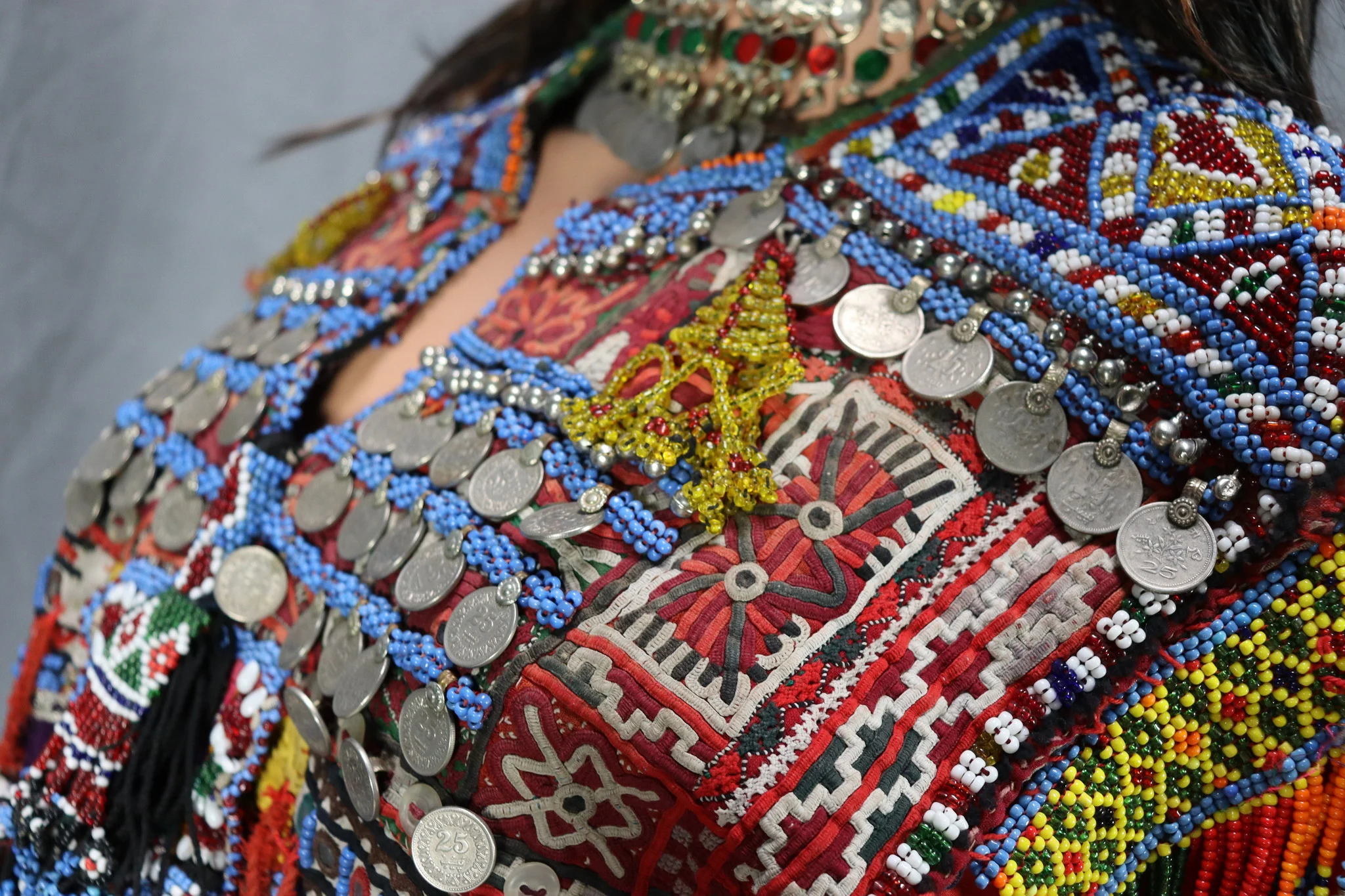
The Kuchi are Afghanistan’s nomadic and semi-nomadic peoples — herders, traders, and craftspeople who have moved with their flocks across the mountains and plains of southern and eastern Afghanistan for centuries. They are among the country’s most culturally distinct communities, and the women of the Kuchi are widely recognised as some of the most skilled embroiderers in Central Asia. A single Kuchi dress, richly covered in silk-floss stitching, shisha mirrorwork, metal coin trim, and glass beadwork, can take three to six months of painstaking evening work to complete. Each piece is unique, created from memory rather than from a printed pattern, and carries the visual language of a tradition passed from mother to daughter across generations.
Learning the Craft
Embroidery skills are taught within the family, starting in childhood. Girls begin learning as young as seven or eight, starting with simple border patterns and graduating to more complex geometric motifs as their skill develops. By the time a young woman reaches her teens, she is expected to be competent enough to work on the elaborate chest panels that are the centrepiece of every ceremonial Kuchi dress. The most accomplished embroiderers are held in high regard within the community, and a woman’s needlework skill is a significant factor in her social standing and marriageability. The work itself is done during rest periods and in the evenings after the day’s work of herding, cooking, and camp management is complete. It is not a profession in the Western sense — it is a fundamental part of daily life, woven into the rhythm of nomadic existence.
The Techniques
Kuchi embroidery employs several distinct techniques, often combined on a single garment:
- Silk-floss stitching is the foundation of the work. Dense, geometric patterns are stitched directly onto the cotton or cotton-blend base fabric using coloured silk floss in a variety of stitches — chain stitch, cross stitch, satin stitch, and herringbone stitch are the most common. The patterns are entirely geometric, built from triangles, diamonds, zigzags, and stepped motifs that interlock to form complex repeating fields. The density of the stitching on a fine piece is remarkable — the base fabric is almost completely hidden beneath layers of silk thread.
- Shisha mirrorwork is a defining feature of Kuchi embroidery. Small round mirrors — typically one to two centimetres in diameter — are attached to the fabric by a framework of embroidery stitches that holds each mirror in place with thread rather than adhesive. This technique is critical to the longevity of the piece: glued mirrors fall off within a few years, while stitched mirrors remain secure for decades, even under the stress of daily wear. The mirrors serve both a decorative and a practical purpose — in the bright Afghan sunlight, they flash and glint with movement, making the wearer visible at a distance.
- Coin trim consists of old metal coins — sometimes genuine currency coins, sometimes decorative blanks — stitched individually along the hems, cuffs, neckline, and sometimes the yoke of the garment. The coins add weight, movement, and a distinctive jingling sound when the wearer walks. On older pieces, the coins themselves can be of numismatic interest, dating from the reigns of various Afghan kings and foreign occupiers.
- Beadwork uses small glass and metal beads worked into borders, fringes, and accents around the embroidered panels. The beads add colour, texture, and sparkle, and they are typically concentrated at the points of maximum visual impact — the chest, the cuffs, and the hem.
Vintage vs Contemporary Pieces
Vintage Kuchi dresses — those estimated at twenty to fifty years old — are prized by collectors and textile enthusiasts for several reasons. First, the quality of the needlework on older pieces is often extraordinarily high, reflecting years of practice and a level of dedication that is increasingly rare. Second, vintage pieces carry the patina of use — faded colours, small repairs, missing coins, areas of wear — that tells the story of the garment’s life. A dress that has been worn, washed, repaired, and loved for thirty years has a presence and a character that a new piece cannot replicate. Third, some of the materials used in older pieces — particularly certain types of silk floss and certain coin denominations — are no longer available, making these pieces irreplaceable.
Contemporary Kuchi embroidery is still produced, though the tradition is under significant pressure from urbanisation, the displacement of nomadic communities, and the availability of cheap factory-printed fabric that imitates the look of handwork without any of the labour. Supporting the market for genuine Kuchi embroidery — whether buying new pieces or collecting vintage ones — directly supports the communities that maintain the craft and provides an economic incentive for young women to continue learning.
How to Care for Kuchi Embroidery
Kuchi dresses and textiles should always be dry cleaned by a specialist who has experience with vintage or ethnic textiles. Inform the cleaner that the piece is hand-embroidered with attached mirrors, metal coins, and possibly glass beads, so they can adjust their solvents and handling accordingly. Never machine wash a Kuchi dress — the metal coins will damage the drum of the machine, the embroidery thread can catch and pull, and the mechanical action of the spin cycle can tear the base fabric.
For storage, lay the piece flat in a clean cotton sheet or drape it over a padded hanger. Do not use a thin wire hanger — the weight of the coins will stretch the fabric and distort the shoulders. Keep the piece away from direct sunlight to prevent fading and away from damp to prevent mildew. Moth protection is advisable if the piece contains wool components.
Browse one-of-a-kind vintage and contemporary Kuchi embroidered dresses and textiles at AfghanOutlet, each piece photographed in detail and sold with measurements and a condition report.