
History of Lapis Lazuli from Badakhshan

There is only one place on earth that has produced gem-quality lapis lazuli continuously for more than six thousand years: the mines at Sar-e-Sang, high in the mountains of Badakhshan Province in northeastern Afghanistan. This is not an exaggeration or a marketing claim — it is an archaeological and geological fact. Every famous piece of lapis lazuli in the history of human civilisation, from the burial mask of Tutankhamun in Egypt to the blue ceiling of the Sistine Chapel in Rome to the ultramarine robes in Vermeer’s Girl with a Pearl Earring, traces its raw material back to this single remote valley in the Hindu Kush mountains.
The Geology
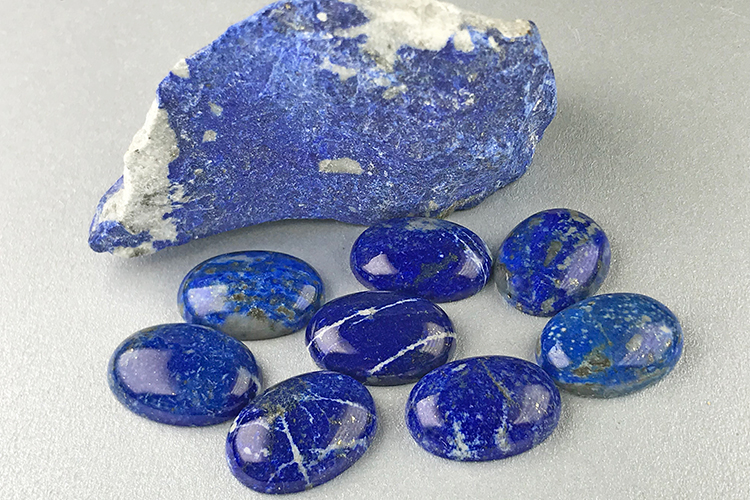
Lapis lazuli is not a single mineral but a metamorphic rock, composed primarily of three minerals in varying proportions. Lazurite provides the intense blue colour and typically makes up between twenty-five and forty per cent of the rock by weight. Calcite appears as white veins and patches running through the blue. Pyrite shows up as bright metallic gold flecks scattered across the surface. The finest lapis, and the most valuable, has a deep, even blue with minimal calcite and a moderate scattering of pyrite. Too much calcite dilutes the blue; too little pyrite makes the stone look flat and lifeless. The ideal balance — vivid blue, a few gold sparks, very little white — is found more consistently at Sar-e-Sang than at any other lapis deposit in the world.
The Ancient Trade
Lapis from Badakhshan reached Mesopotamia by at least 3000 BCE, carried along trade routes that predated the Silk Road by two thousand years. The Sumerians prized it above almost every other material. They carved it into cylinder seals — small stone rollers used to press identifying marks into wet clay — and into figurines, jewellery, and inlays for furniture and musical instruments. The Royal Tombs of Ur, excavated in modern-day Iraq in the 1920s, contained hundreds of lapis objects, all of which chemical analysis has traced to Afghan sources.
In Egypt, lapis was associated with the heavens and the divine. It was carved into scarabs and amulets, ground into powder for eye cosmetics, and inlaid into the gold of pharaonic jewellery. The famous funeral mask of Tutankhamun uses lapis for the eyebrows and the stripes of the nemes headdress. All of it came from Badakhshan — there was simply no other source of gem-quality material in the ancient world, and Egypt had no native deposits of any kind.
Ultramarine: The Pigment That Changed Art
In medieval and Renaissance Europe, lapis lazuli was ground into a pigment called ultramarine — from the Latin ultramarinus, meaning “beyond the sea,” because the stone had to be imported from so far to the east. Ultramarine was the most expensive pigment available to painters, more costly per gram than gold leaf, and its use was strictly regulated by patrons and contracts. In many commissioned works, the contract specified exactly which passages of the painting could be executed in ultramarine and which had to use cheaper blue alternatives like azurite or smalt.
The process of extracting the pigment was laborious. The raw lapis had to be ground to a fine powder, mixed with melted wax, pine resin, and lye, kneaded for days, and then washed repeatedly to separate the pure blue lazurite particles from the grey calcite and pyrite. The first wash produced the finest, most intense pigment; later washes yielded progressively paler and less saturated blues. The best ultramarine was reserved for the most sacred subjects — the robes of the Virgin Mary, the sky of paradise — while the weaker washes were used for less important passages.
Johannes Vermeer, the Dutch master, was so devoted to ultramarine that he used it not only for obvious blue passages but mixed it into his shadows, his whites, and his flesh tones to give them a cool luminosity. He died heavily in debt, and art historians believe his profligate spending on ultramarine was a significant factor. Michelangelo, working on the Sistine Chapel, left the panel of the Entombment unfinished because he could not obtain enough ultramarine to complete the sky. The painting remains incomplete to this day.
In 1826, a French chemist named Jean-Baptiste Guimet synthesised artificial ultramarine in a laboratory, making the natural pigment commercially obsolete almost overnight. The synthetic version was chemically identical and visually indistinguishable, but it cost a fraction of the price. The pigment trade collapsed, but the demand for lapis lazuli as a gemstone continued unabated.
What Makes Badakhshan Lapis Superior
Other deposits of lapis lazuli exist in Chile, Russia, Myanmar, Pakistan, and several other countries, but none match Badakhshan for the consistency and depth of the blue. Chilean lapis, from the Flor de los Andes mine in the Coquimbo region, tends to be paler and more heavily veined with calcite, giving it a washed-out appearance compared to Afghan material. Russian lapis from the shores of Lake Baikal is often streaked with heavy calcite banding and lacks the even, saturated colour that defines top-grade Afghan stone. The geological conditions at Sar-e-Sang — a specific combination of limestone, granite, and contact metamorphism — produce lazurite crystals of exceptional purity and colour intensity that simply do not occur with the same consistency elsewhere.
Buying Lapis Today
When buying lapis lazuli jewellery or decorative objects, look for deep, even blue colour with visible pyrite flecks and minimal white calcite veining. Ask the seller whether the stone has been dyed, coated, or stabilised — all common treatments that mask low-grade material. Genuine, untreated lapis has a slightly waxy lustre and a granular surface texture under magnification. Dyed lapis will bleed colour when wiped with an acetone-soaked cotton swab. Coated lapis has an unnaturally glossy surface that feels plastic rather than mineral.
The price of lapis varies enormously with quality. Low-grade material with heavy calcite and little blue can sell for a few dollars per gram. Top-grade Afghan lapis with intense, even colour and good pyrite sells for significantly more, though it remains far more affordable than comparable precious stones.
Browse untreated Badakhshan lapis lazuli jewellery at AfghanOutlet, with every stone’s origin confirmed and its treatment status — always none — clearly stated in the listing.