
Hand-Knotted Kazak Wool Rug Buying Guide

Afghan rugs have been traded along the Silk Road for centuries, but the global market today is flooded with machine-made copies sold as handmade. Whether you are furnishing a living room, building an art collection, or simply looking for a floor covering that will last a lifetime, knowing how to tell a genuine hand-knotted rug from a factory reproduction protects your investment and supports the artisans who spend months at the loom creating each piece by hand.
Flip the Rug Over
This is the single most reliable test you can perform, and it takes only a few seconds. On a genuine hand-knotted rug, the pattern is clearly visible on the back, rendered in the same colours as the front but slightly rougher in texture. The individual knots are visible as small bumps, and they will not be perfectly uniform — because a human hand tied each one. A machine-made rug, by contrast, has a uniform, perfectly symmetrical back, often with a synthetic mesh foundation visible between the rows of pile. The regularity is the giveaway: no human hand produces that level of mechanical precision.
Run your hand across the back of the rug. Hand-knotted work feels bumpy and textured, like the surface of a cobblestone path. Machine-made rugs feel flat and smooth, more like printed fabric glued to a canvas backing. If the seller will not let you turn the rug over, that tells you something too.
Check the Fringe
The fringe on a hand-knotted rug is a structural part of the piece — it is the continuation of the cotton or wool warp threads that run the full length of the rug. It grows out of the body of the rug itself, and you cannot separate it from the weave without destroying the rug. On machine-made pieces, the fringe is a separate strip of yarn that is sewn or glued onto the finished edge after production. Tug gently at the fringe where it meets the rug body. If it lifts away cleanly, or if you can see a line of stitching or adhesive, the fringe was attached rather than woven, and the rug is not hand-knotted.
Examine the Knot Density
Turn the rug over and count the knots in a one-inch square. You can use a magnifying glass to make this easier. Count the number of knots along one inch in one direction, then count along one inch in the perpendicular direction, and multiply the two numbers to get the knots per square inch. Afghan rugs typically range from 60 to 200 knots per square inch depending on the regional tradition and the fineness of the weave. Kazak and Turkmen rugs tend to sit at the lower end of this range with a thicker, more robust pile. Baluch rugs and pieces from Herat are often finer, with knot counts above 120. A higher count generally means finer detail, more hours of labour, and a higher price — but it does not automatically mean a better rug. Some of the most prized pieces in the world have relatively low knot counts but extraordinary wool and colour.
Look at the Dyes
Natural dyes behave differently from synthetic ones, and the difference is visible if you know what to look for. Natural dyes produce colours that shift subtly across the surface of the rug, a characteristic known as abrash. You might notice the red deepening or lightening in horizontal bands across the field. This happens because the wool is dyed in batches, and each batch absorbs the dye slightly differently depending on water temperature, steeping time, and the natural variation of the dyestuff. Synthetic dyes, by contrast, produce perfectly uniform colour from one end of the rug to the other.
To test further, part the pile of the rug and look at the base of the fibres where they emerge from the knot. Natural dyes penetrate the wool unevenly, so you will see the colour fade or lighten toward the root. Synthetic dyes coat the fibre uniformly from tip to root with no visible gradation. This is one of the hardest tests to fake, which makes it one of the most reliable.
Know the Regional Patterns
Afghan rugs come from several distinct weaving traditions, each with its own recognisable vocabulary of motifs and colour palettes. Learning even the basics helps you evaluate a rug and spot a seller who does not know — or will not say — where the piece was actually made.
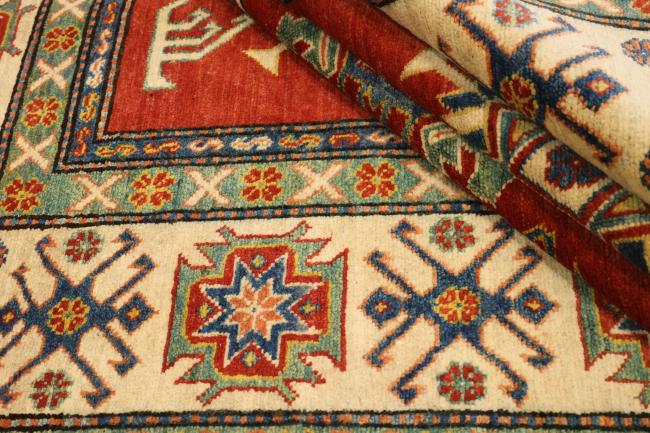
- Kazak rugs feature bold geometric medallions in strong reds, blues, and ivory. The pile is thick and the wool is often particularly lustrous. These are woven in northern Afghanistan and across the border into the Caucasus region.
- Turkmen rugs are characterised by repeating octagonal motifs called guls, set in rows against a deep burgundy or liver-coloured field. The weave is tight and the pile is relatively short.
- Baluch rugs are typically small prayer rugs with dark, moody palettes — deep blues, browns, and blacks — often featuring the tree-of-life motif or angular geometric prayer niches.
- Kilim is a flat-woven textile with no pile at all. The patterns are created by the interlocking of differently coloured weft threads. Kilims are lighter, less expensive, and often feature striking zigzag and diamond geometrics in bold colours.
- Herat rugs show Persian influence in their finer weave and more curvilinear designs. Floral elements, arabesques, and the herati fish pattern are common.
If a seller cannot tell you the weaving region or tradition a rug comes from, treat that as a warning sign. Reputable dealers know exactly where their inventory was made and can explain the tradition behind each piece.
The Burn Test
This is a last resort, and it only works with the seller’s explicit permission. Clip a tiny fibre from the very back of the rug — a single thread is enough. Hold it with tweezers and bring a flame to it. Wool, which is the primary material in authentic Afghan rugs, smells like burning hair when ignited and leaves a soft, crushable ash. Synthetic fibre — polyester, polypropylene, or nylon — melts into a hard plastic bead and produces a sharp chemical smell. Cotton, which is often used as the foundation of a wool-pile rug, burns cleanly with a papery smell and leaves a fine grey ash. The burn test tells you what the rug is made of but not whether it is hand-knotted, so use it alongside the other tests rather than in isolation.
What to Ask the Seller
A knowledgeable and honest seller should be able to answer all of the following questions without hesitation:
- Where was this rug woven, and by whom — an individual weaver, a family workshop, or a village collective?
- What is the foundation made of — cotton, wool, or silk?
- Are the dyes natural or synthetic, and if natural, which dyestuffs were used?
- What is the approximate knot count per square inch?
- How old is the piece, and has it been repaired or restored?
Vague answers — “it is from Afghanistan” or “it is very old” — suggest the piece has passed through too many hands for anyone to trace its real origin. At AfghanOutlet, every rug listing includes the weaving region, foundation material, dye type, and approximate knot density, because we believe provenance matters as much as the pattern.