
Istalif Pottery: Afghanistan Turquoise Ceramics

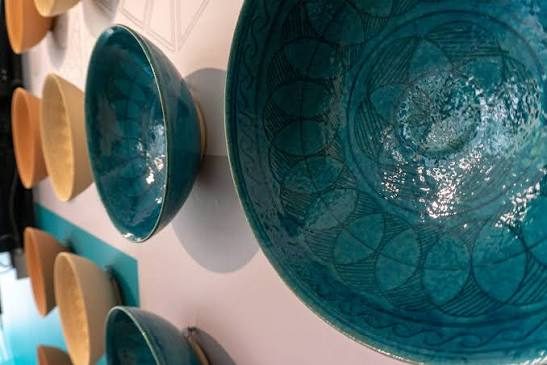
The village of Istalif sits in the Shomali Plain about fifty kilometres north of Kabul, tucked into the foothills of the Hindu Kush mountains and surrounded by orchards of grape, pomegranate, and mulberry. It is a small place — a few thousand people — but it has been a pottery centre for centuries, and its signature product is recognised across Afghanistan and increasingly around the world: a turquoise-glazed ceramic made from locally dug clay and coloured with a glaze derived from ground copper ore found in the hills above the village.
A History Written in Clay
Pottery production in Istalif predates written records in the region. Archaeological fragments suggest that the area has been producing glazed ceramics since at least the fifteenth century, though the tradition is almost certainly older. The village was heavily damaged during the wars of the 1990s and early 2000s, and many potters fled to Pakistan or Kabul. But the tradition survived, carried in the hands and memories of the craftspeople who returned to rebuild their workshops from the rubble. Today, a new generation of potters is working in Istalif, using the same techniques and the same local materials as their predecessors.
How Istalif Pottery Is Made
The process has not changed significantly in generations, and every step is done by hand. Potters dig their own clay from deposits in the hills above the village. The raw clay is cleaned of stones and debris, soaked in water, kneaded by hand to an even consistency, and left to rest before throwing. The potter works at a foot-powered kick wheel — there is no electricity involved, no motor, no mechanical assistance. The pot is formed by hand on the spinning wheel, shaped by feel and by eye rather than by measurement or template. Finished pieces are set outside to dry in the open air for several days, depending on the weather and the thickness of the walls.
Once dry, the pots are loaded into a wood-fired kiln for the first firing, known as the bisque firing. This hardens the clay but leaves it porous and unglazed. After cooling, the glaze is applied. The turquoise glaze is made by grinding copper ore — collected from the same hills that supply the clay — to a fine powder, mixing it with water and a flux to lower its melting point, and brushing it onto the surface of the bisque-fired pot by hand. A second firing in the wood kiln melts the glaze into a smooth, glassy surface. Because the kiln is fuelled by wood and the temperature varies significantly from the top to the bottom and from the front to the back, no two pieces emerge with exactly the same colour. Some are deep teal, some are closer to aqua, some have green or grey undertones, and some develop patches where the glaze pooled thicker and the colour deepened.
Why Every Piece Is Different
There are at least four independent sources of variation in every piece of Istalif pottery, and they are cumulative:
- The clay — mineral content varies even within the same hillside, affecting how the clay shrinks during drying and firing and how it interacts with the glaze.
- The wheel — pieces are thrown by eye, not measured against a template, so wall thickness, rim diameter, and overall proportions shift from pot to pot.
- The glaze — applied by brush, so it naturally pools in the curves and thins on the high points, producing colour variation across a single piece.
- The kiln — wood-fired kilns produce temperature gradients across their interior that affect glaze colour, texture, and maturity. A pot near the firebox may come out ten shades darker than one near the flue.
This variation is not a defect or a sign of poor quality. It is the entire point. Machine-made ceramics deliver perfect uniformity because they are produced by automated systems designed to eliminate variation. Istalif pottery delivers individuality because it is produced by a human being working with natural materials in conditions that are inherently variable. If you want two identical bowls, buy factory ceramics. If you want two bowls that are recognisably from the same tradition but unique in their details, Istalif delivers that, and always has.
What to Look For When Buying
Fine crazing — a network of tiny hairline cracks in the glaze surface — is completely normal in Istalif pottery and is not a defect. It occurs because the clay body and the glaze shrink at slightly different rates as they cool after firing. The crazing does not affect the structural integrity of the piece or its food safety. Heavy cracks that you can feel with a fingernail, on the other hand, may indicate a problem — either a firing fault or physical damage. The foot ring at the base of the pot should be unglazed, showing the raw clay beneath. This is where the pot sat on the kiln shelf during firing, and it is a normal feature of all kiln-fired ceramics. Bright, even colour across the whole piece generally indicates a good kiln position and a well-applied glaze. Very pale, very uneven, or muddy colour may indicate under-firing, which produces a softer and less durable glaze.
Care and Use
Istalif pottery is food safe and lead-free — the copper-oxide glaze contains no lead or other toxic metals. It is suitable for serving food at the table: salads, fruit, bread, nuts, and other room-temperature items. Hand wash in warm water with a mild detergent and dry promptly. Do not put Istalif pottery in a dishwasher — the high water temperature, harsh detergents, and mechanical action will dull and eventually damage the glaze surface. Do not use it in a microwave or conventional oven, as the thermal shock of rapid heating or cooling can crack the glaze and potentially the clay body beneath it.
Browse the full range of Istalif bowls, plates, serving dishes, and decorative vases at AfghanOutlet, each one handmade in the village and shipped directly to your door.